

The Minas Gerais Conspiracy
Was Tiradentes truly a hero or a scapegoat?


The Minas Gerais Conspiracy
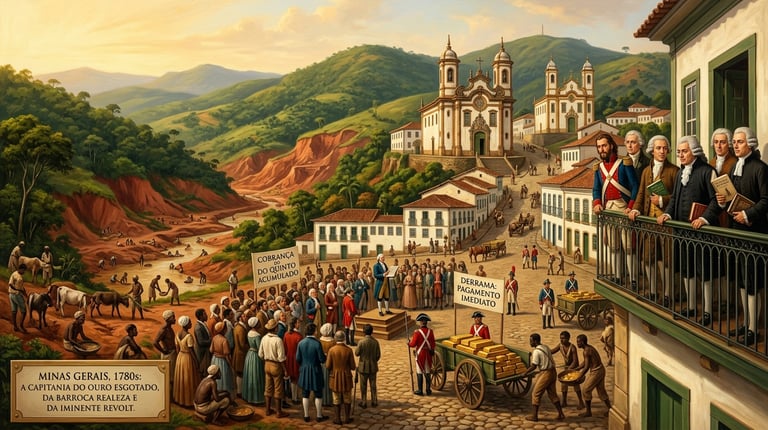
During the 18th century, Brazil experienced a period of intense colonial exploitation, particularly in gold-rich regions like Minas Gerais. Within this context, the Brazilian economy was deeply rooted in the gold cycle, which generated massive wealth for the Portuguese Crown. This cycle not only prompted the migration of colonists to the region but also established a highly lucrative yet oppressive system of production and extraction. Gold extraction was tied to a heavy tax burden, the most prominent being the quinto (the fifth), which consisted of a mandatory 20% tax on all extracted gold, causing widespread discontent among miners.
This adverse economic scenario contributed to a climate of social dissatisfaction. The colonists, known as mineiros, faced the pressure of high taxes and exploitation by the Portuguese Crown, which seized their wealth without offering fair compensation in return. Furthermore, there was growing discontent regarding the colonists' lack of political representation in the colonial administration. Decisions and laws were frequently imposed by the Crown without any consideration for local needs or interests.
However, the tensions were not solely economic. Enlightenment ideas, which preached liberty, equality, and individual rights, began to permeate Brazilian society, leading many to question the legitimacy of Portuguese rule. The mineiros began organizing around ideals of autonomy and freedom, fostering the revolutionary ideas that would culminate in the Minas Gerais Conspiracy (Inconfidência Mineira). Thus, the social and economic context, riddled with political apprehensions, formed an environment ripe for revolt against colonial oppression and the injustices that permeated the lives of the colonists in Minas Gerais.
Who Was Tiradentes?
Joaquim José da Silva Xavier, better known as Tiradentes, was born on November 12, 1746, in Minas Gerais, Brazil. From a young age, he expressed an interest in medicine and later trained as a dentist. His career choice, however, was not the only aspect that defined him. Tiradentes also distinguished himself in the military, where he achieved the rank of alferes (second lieutenant), reflecting a multifaceted profile that encompassed technical skills and leadership. Tiradentes' upbringing in a colonial context sharpened his awareness of the oppression exerted by Portugal over the colonies.
Tiradentes' involvement in the Minas Gerais Conspiracy was motivated by a growing discontent with colonial exploitation, especially the relentless collection of taxes, such as the derrama (a mandatory tax collection to fulfill unpaid gold quotas). He became one of the leaders of this movement, which aimed for independence and the formation of a republic. Beyond his professional qualifications, Tiradentes was known for his deep commitment to freedom and social justice. This ethos led him to foster an environment of debate regarding colonial autonomy, drawing in intellectuals, merchants, and other segments of society in Minas Gerais.
The figure of Tiradentes transcends that of a mere dentist or soldier; he became a symbol of resistance against injustice and oppression. His dedication to the ideal of equality and liberty distinguished him from his contemporaries and earned him a heroic status, though an analysis of his trajectory reveals complex nuances. While some revere him as a national hero, others question whether he was a scapegoat in a broader conflict between the colonizers and the colonized. Therefore, when exploring Tiradentes' life, we must consider both his achievements and the circumstances that surrounded him.
The Revolt of the Minas Gerais Conspiracy
The Revolt of the Minas Gerais Conspiracy, which took place in 1789, is considered one of the most significant milestones in the struggle for Brazilian independence. The roots of this movement can be traced back to a context of social and economic dissatisfaction that intensified in Minas Gerais during the late 18th century. The colonists were discontented with the high taxes imposed by the Portuguese Crown, especially the tax on gold and the prohibition of free trade, both of which stifled local prosperity.
The movement gained momentum under the influence of Enlightenment ideas that promoted liberty and equality, inspiring prominent figures such as Tiradentes, Cláudio Manuel da Costa, and other intellectuals of the era. These inconfidentes (conspirators), as they were called, met secretly to discuss their aspirations for autonomy and the creation of an independent republic.
These meetings, held in clandestine locations, were moments of intellectual fervor where the ideals of the American Revolution and the French Revolution echoed in the revolutionaries' conversations. The motto "liberty" began to resonate strongly, and the desire for a rupture with colonial control became increasingly present in the minds of the conspirators. Furthermore, the broader context of separatist movements in Latin America created a favorable environment for insurgency, suggesting that Minas Gerais might not be alone in its struggle.
However, the revolt was quickly discovered by Portuguese authorities, culminating in the arrest and execution of several of its leaders, including Tiradentes, which turned him into a symbol of resistance against oppression. Although the Minas Gerais Conspiracy failed in its immediate objective, it left a lasting legacy that would echo through future generations in Brazil and the emancipation efforts that followed.
Tiradentes as a National Hero
The figure of Tiradentes, whose real name was Joaquim José da Silva Xavier, emerged as one of the most significant symbols in the construction of Brazilian national identity. His image is frequently portrayed as that of a hero, a martyr for freedom who fought against Portuguese colonial oppression at the end of the 18th century. By analyzing Brazilian historiography and the texts that recount his life and the Minas Gerais Conspiracy, it is observable that his image was carefully shaped over time by various historians and intellectuals.
With the Minas Gerais Conspiracy—a movement aimed at economic and political freedom—Tiradentes became the emblematic leader of the fight against injustice. His execution on April 21, 1792, was interpreted as a sacrifice in the name of liberty, transforming him into an icon of resistance to tyranny. The way the narrative surrounding Tiradentes was constructed over the centuries reflects the social and political needs of each era. The cult of his personality grew particularly in the 19th century, when nationalism began to flourish in Brazil.
Tiradentes' heroism is highlighted in various cultural expressions, such as literature, theater, and music, which helped consolidate his image as a national hero. The creation of monuments, as well as the inclusion of his name in important civic dates, such as Tiradentes Day, emphasizes his relevance in building the Brazilian nation. The narrative of Tiradentes as a hero transcended his specific role in the Conspiracy, becoming a symbol of the struggle for justice and equality. Thus, his legacy resonates deeply within Brazilian national identity to this day.
Tiradentes as a Scapegoat
The figure of Joaquim José da Silva Xavier, better known as Tiradentes, holds a central place in Brazilian history, not only as one of the primary leaders of the Minas Gerais Conspiracy but also as an emblematic figure who was often viewed as a scapegoat. This perspective suggests that, although Tiradentes was a martyr in the name of the struggle for independence, his execution may have been used as a political tool to divert attention from the true orchestrators of the insurrection.
The conspirators who conceptualized and planned the revolt were in a complex and risky position; by establishing Tiradentes as the main culprit, they managed to deflect the colonial government's scrutiny away from themselves. In this context, the idea of an individual sacrifice transforms into a collective protection mechanism for the other members of the movement, who remained unharmed while Tiradentes faced the full rigor of the punishment. This mobilization of the martyr serves to emphasize the magnitude of the struggle, but it also reveals the intricate power dynamics among the conspirators themselves.
Furthermore, the construction of the narrative surrounding Tiradentes, who was later exalted as a national hero, raises questions about the manipulation of historical memory. Through his execution, the Portuguese government not only eliminated a potential social disruptor but also consolidated a symbol that could be used to reinforce the need for control and order. Thus, the view of Tiradentes as a scapegoat is not just a matter of assigning responsibility, but also a reflection on how historical events can be reinterpreted over time to serve a desired narrative.
Legacy of the Minas Gerais Conspiracy
The Minas Gerais Conspiracy, one of the most significant episodes in the struggle for independence in Brazil, left a profound legacy that still resounds in contemporary society. The movement, which culminated in the capture and execution of Tiradentes, was articulated not only around resistance to colonial rule but also around issues of national identity and autonomy. The martyrdom of Tiradentes, who became a symbol of the fight for freedom, inspired subsequent generations to reflect on the concept of patriotism and the sacrifices necessary to achieve independence.
The impact of the Minas Gerais Conspiracy extended beyond its immediate time; it influenced not only subsequent political movements, such as the Revolution of 1930 and the Proclamation of the Republic in 1889, but also manifested in cultural expressions. Tiradentes' figure was romantically reinterpreted in literature and the arts, elevating him to the status of a national hero, even when his actual political influence during his lifetime remains a subject of debate. This construction of his image reflects a collective need to find symbols of struggle and resistance in a past where colonial oppression was a reality.
Today, the legacy of the Minas Gerais Conspiracy is remembered in various celebrations and symbols within Brazilian culture. Tiradentes' figure, though controversial, is celebrated as a martyr for freedom, and his memory is intertwined with the ideals of autonomy and social justice in the collective memory of the Brazilian people. This recognition of his legacy is intrinsically linked to a constant process of historical reinterpretation, which seeks to value the people's struggle in the pursuit of rights and the questioning of authority. Thus, the Minas Gerais Conspiracy not only paved the way for independence but also contributed to the formation of a new national ethos grounded in the ideals of liberty and justice.
Conclusion: Hero or Scapegoat?
The figure of Joaquim José da Silva Xavier, known as Tiradentes, has generated intense debates among historians, scholars, and the general public. Throughout this text, evidence examining the complexities of the Minas Gerais Conspiracy has been presented, highlighting both the Enlightenment ideals that inspired Tiradentes and the political and social realities of the era. In many accounts, he is celebrated as a national hero, a symbol of the fight for freedom and justice against colonial oppression. This view portrays him as a martyr for the republican cause, whose death reverberated through generations, inspiring revolutions and social movements in search of autonomy and rights.
However, there is also a perspective that presents him as a scapegoat—an individual sacrificed in the name of a larger, more complex movement filled with nuances. The Minas Gerais Conspiracy was not a unanimous effort, and many of its participants distanced themselves from Tiradentes' leadership, which may indicate that he became a convenient target for repression. Critical analysis reveals how the historical context contributed to his arrest and execution, making him a symbol of injustice and an example of the power the State exerts over the individual.
These opposing interpretations illustrate the duality of Tiradentes, who, over time, has been reinterpreted according to the needs and ideals of each era. The study of history is crucial, as it allows us to reflect on how figures like Tiradentes are shaped and adapted to contemporary contexts, revealing the injustices and struggles for freedom that persist. Therefore, when considering Tiradentes, it is essential to recognize his role as a product of his time, while simultaneously valuing the importance of learning from the past to understand the present.
📚 Continue Exploring Key Points in History:


contato@pontoschavedahistoria.com.br
© 2026. All rights reserved.