

The Mali Empire
The Golden Age of West Africa
The Golden Age of West Africa
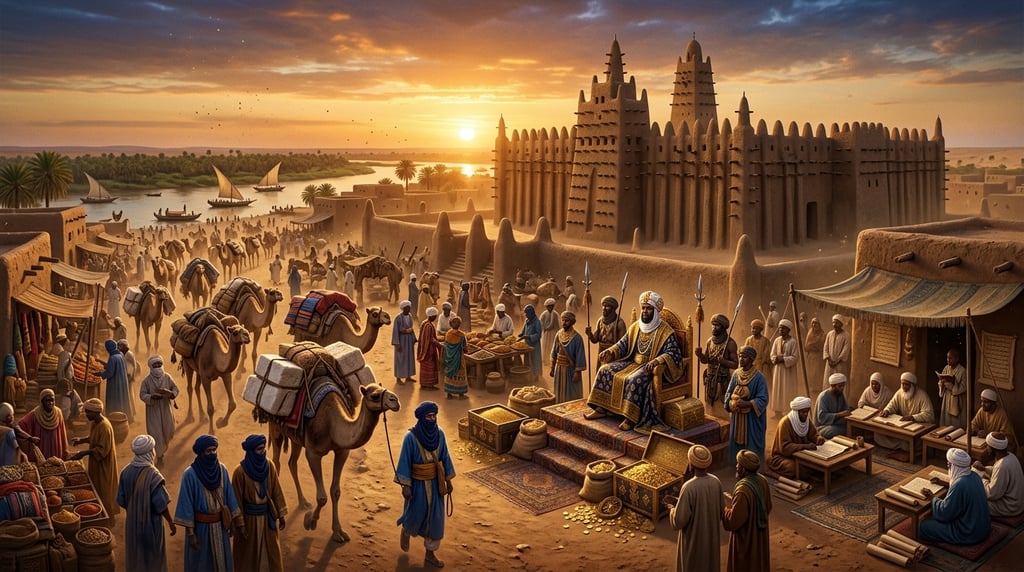
The Mali Empire, one of the most prominent civilizations in West Africa, reached its peak between the 13th and 15th centuries. The empire was located in a region that today encompasses parts of modern-day Mali and sought to consolidate control over the trans-Saharan trade routes, which were essential to the region’s economy. Thanks to its strategic location, the Mali Empire became a meeting point for merchants and travelers, facilitating the exchange of goods, ideas, and cultures.
The capital of the empire, Niani, and later Timbuktu, flourished as centers of learning and commerce. Timbuktu, in particular, became famous for its historic universities and libraries, reflecting a high level of education and a deep investment in sciences and literature. The reputation of Timbuktu made it a global reference point, attracting scholars and travelers from different parts of the world. The diversity of cultures and the expansion of Islam contributed to an era of great cultural and intellectual advancement, defining the golden age of the empire.
Historically, the impact of the Mali Empire extended far beyond its borders, influencing various African societies and international trade networks. The wealth of the empire, acquired mainly through the trade of gold and salt, not only brought internal prosperity but also attracted the attention of external powers, including the Arab world and Europe. The splendor of the Mali Empire laid the foundations for future states in the region and shaped the political and economic landscape of West Africa for centuries.
The Historical Roots of the Empire
The Mali Empire, one of the most powerful states in West Africa, has deep historical roots that date back centuries before its rise as an imperial power. Local tribes, especially the Mandinka people, played a crucial role in forming the region’s social and cultural foundations. These tribal societies were organized into clans and maintained a rich oral tradition that preserved knowledge about governance, trade, and cultural practices, creating an essential foundation for social unity and eventually for the formation of the empire.
One of the most significant factors behind the rise of the Mali Empire was trans-Saharan trade. This trade network not only enabled the exchange of goods but also facilitated the movement of ideas and cultural influences between North Africa and the interior of the continent. Resources such as gold, salt, and enslaved people moved through these commercial routes, enriching local leaders and promoting prosperity in the city-states that would eventually unite under the banner of the Mali Empire.
Merchants, taking advantage of established trade routes, introduced new religions and practices, especially Islam, which continues to influence the cultural traditions of the region today.
Furthermore, interactions with different peoples, including Arabs and Berbers, introduced technologies and knowledge that were fundamental to the development of cities such as Timbuktu. This city would later become a thriving center of learning and commerce, symbolizing the cultural wealth of the empire.
Therefore, the historical roots of the Mali Empire were shaped by a complex combination of tribal traditions, commercial dynamism, and cultural exchanges that culminated in the emergence of one of the most sophisticated civilizations in West Africa.
Mansa Musa: The Great Emperor
Mansa Musa, who ruled the Mali Empire during the 14th century, is widely recognized as one of the most remarkable emperors in African history. His reign, which lasted from 1312 to 1337, is remembered not only for the immense wealth he accumulated but also for his journeys and his significant contributions to the cultural and economic development of the empire. Under his leadership, Mali became a prosperous center of trade and knowledge, attracting scholars, artists, and architects from different parts of the world.
One of the most striking aspects of Mansa Musa’s reign was his reputation as the wealthiest person in history. His fortune was so vast that during his pilgrimage to Mecca in 1324, he distributed enormous amounts of gold along the way, significantly affecting the economies of the regions he passed through. This journey not only strengthened his image as a powerful ruler but also changed the world’s perception of Africa, revealing a continent rich in resources and cultural achievements, in contrast to the limited and often inaccurate views that existed at the time.
Beyond his economic achievements, Mansa Musa was also a great patron of the arts and education. He supported the creation of educational institutions, including the famous University of Timbuktu, and encouraged the construction of mosques and centers of learning that became cultural landmarks throughout the region.
His era was not only a golden age of material wealth but also a period of extraordinary intellectual and cultural growth. Mansa Musa’s legacy demonstrates how visionary leadership can transform the destiny of a nation and influence how an entire continent is perceived by the world.
The Economy of the Mali Empire
The economy of the Mali Empire was remarkably vibrant and diverse, supported by a combination of natural resources and an extensive trade network. Gold was one of the empire’s most important resources and was extracted from mines located in the southern regions, especially in areas such as Bambuk and Bure. The abundance of gold attracted merchants from distant lands and helped Mali become one of the world’s largest producers of gold during its peak.
The wealth generated from gold trade contributed to the accumulation of enormous fortunes by Mali’s rulers, including the famous Mansa Musa. The empire’s control over gold resources gave it significant influence over international commerce and strengthened its position among powerful civilizations of the medieval world.
Besides gold, salt was another essential resource that supported the economy. Extracted mainly from the salt mines of Taghaza, salt was considered almost as valuable as gold because it was necessary for food preservation and human health. The trade between northern and southern regions was maintained by caravans that crossed the vast Sahara Desert, transporting salt, gold, and other valuable goods.
The Mali Empire’s commercial infrastructure was highly developed, with trade routes connecting major cities such as Timbuktu and Gao to distant regions of North Africa and even Europe. These routes allowed the exchange of goods, knowledge, cultures, and ideas, contributing to the empire’s prosperity.
Therefore, the combination of natural resource management, especially gold and salt production, along with a powerful trade network, created the economic foundation that allowed the Mali Empire to become one of the greatest civilizations in African and world history.
Culture and Education in the Empire
During its golden age, the Mali Empire stood out not only for its military and economic achievements but also for its vibrant cultural and educational environment. One of the most remarkable aspects of this period was the development of learning centers in cities such as Timbuktu, which became symbols of knowledge and education.
Timbuktu, in particular, was home to the famous University of Sankore, one of the most important centers of learning in the medieval world. Students from various regions traveled there to study subjects such as theology, astronomy, mathematics, law, and literature.
The literary production of the Mali Empire was another major cultural achievement. Manuscripts, poems, and academic works were created and preserved, reflecting a strong intellectual tradition that valued education and critical thinking. Scholars contributed to the recording of history, philosophy, science, and religious studies, demonstrating the empire’s commitment to knowledge.
Education was not limited only to scholars and elites; it was an important part of society and helped spread knowledge across different communities.
Furthermore, religious tolerance and cultural diversity played a crucial role in the intellectual growth of the Mali Empire. The coexistence between Muslims and followers of traditional African beliefs created a unique environment of cultural exchange that encouraged creativity and innovation.
The artistic and architectural achievements of the empire, such as the famous Great Mosque of Djenné, demonstrate how Islamic and African influences combined to create a unique cultural identity.
The Fragmentation and Decline of the Empire
The fragmentation of the Mali Empire, once one of the most powerful and influential states in West African history, occurred due to a combination of internal and external factors.
Among the external pressures was the rise of neighboring powers and competition for resources. As the empire expanded, maintaining control over its vast territory became increasingly difficult. Emerging states, especially the Songhai Empire, began challenging Mali’s dominance, leading to military conflicts that weakened the empire’s unity.
Internal struggles also played an important role in Mali’s decline. Conflicts over succession, political rivalries, and disputes among regional leaders weakened the authority of the emperor. Local governors and tribal chiefs increasingly challenged central power, reducing the empire’s ability to maintain control over its territories.
Economic difficulties further contributed to the decline. The Mali Empire depended heavily on trans-Saharan trade, and changes in commercial routes reduced its influence. Competition over valuable resources and the weakening of trade networks gradually decreased the empire’s wealth, making it harder to maintain its armies and infrastructure.
As a result, the combination of political instability, economic challenges, and external pressures caused the gradual fragmentation of the Mali Empire. This transformation opened the way for new powers in West Africa, including the rise of the Songhai Empire.
Legacy and Impact of the Mali Empire
The Mali Empire left a lasting legacy that continues to influence African culture, history, and identity today. One of its greatest contributions was the development of rich artistic and cultural traditions that shaped communities throughout West Africa.
Music, storytelling, literature, and oral traditions remain essential parts of African identity, preserving the experiences and knowledge passed down through generations.
The empire also played a crucial role in the spread of education and intellectual development. Timbuktu became one of the world’s most important centers of learning during the medieval period, attracting scholars from across Africa and the Islamic world. The manuscripts preserved in institutions such as the University of Sankore remain valuable historical sources that demonstrate the sophistication of African scholarship.
The economic influence of the Mali Empire also cannot be underestimated. By controlling major trans-Saharan trade routes, Mali connected different regions through the exchange of goods, ideas, and cultures. These connections helped shape the economic and cultural development of West Africa for centuries.
The story of the Mali Empire challenges outdated views about Africa’s past by revealing a civilization built on knowledge, wealth, innovation, and cultural achievement.
Its legacy extends beyond geographical borders, reminding the world of Africa’s important role in global history.
Studying and celebrating the Mali Empire allows new generations to recognize the richness of African civilizations and understand a more complete story of human history.
📚 Continue Exploring the Key Points of History:
Ancient Roman Sanitation
Gladiator Diet
Júlio César: Como o General Romano Transformou a República em Império
contato@pontoschavedahistoria.com.br
© 2026. All rights reserved.