

The Cry of Ipiranga
Myths and Realities about the Independence of Brazil in 1822
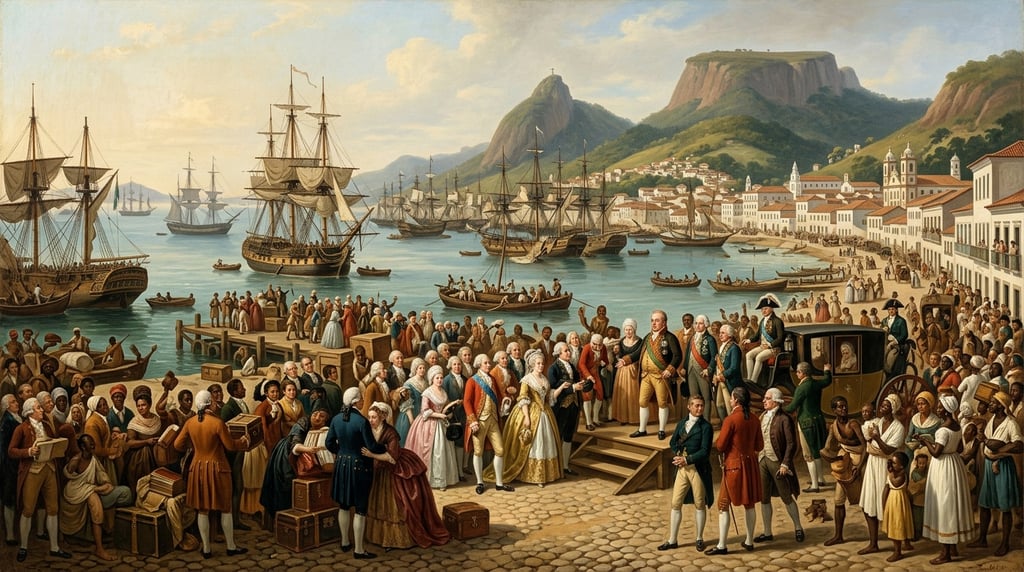
The Cry of Ipiranga
The Cry of Ipiranga, which occurred on September 7, 1822, represents a fundamental milestone in the history of Brazil, symbolizing the country's struggle for independence from Portugal. This event not only catalyzed political emancipation but also reflected a complex historical and social context, where desires for freedom and autonomy were intertwined with the political and economic interests of the era.
During the late 18th and early 19th centuries, Brazil was undergoing a phase of great transformation, marked by social and political tensions. The influence of Enlightenment ideas, which championed the natural rights of man and the sovereignty of peoples, reverberated throughout the American colonies, including Brazil. The opening of the ports to friendly nations in 1808 and the transfer of the Portuguese court to Brazil in 1808 (and its subsequent return in 1821) were events that intensified conflicts of interest between colonists and the metropole.
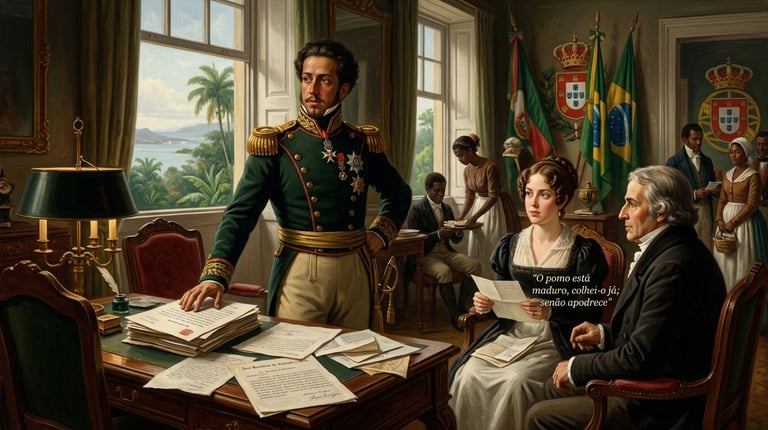
Within the political context of the time, the appointment of Dom Pedro I as prince regent of Brazil, following the Portuguese constitutional crisis, generated internal disputes over the territory's autonomy. Pressures for independence intensified, leading to the need for a formal declaration that would distinguish Brazil as a sovereign nation. Dom Pedro's famous cry on the banks of the Ipiranga Brook not only symbolized this desire for independence but also established the figure of the emperor as the leader of a new country.
Independence, therefore, transcends the mere act of separation from Portugal. It represents the emergence of a new national identity, with a profound impact on the social, political, and economic relations that would shape Brazil in the following decades. This pursuit of autonomy continues to resonate to this day, making the Cry of Ipiranga a powerful symbol of the struggle for independence and the building of modern Brazil.
The Social and Political Context of Brazil in 1822
In 1822, Brazil was experiencing a period of intense social and political transformations that would culminate in the country's declaration of independence from Portugal. The Portuguese colonial administration, which had exercised control over Brazil for more than three centuries, began to be challenged by different segments of society. Popular dissatisfaction was fueled by a variety of factors, including high taxes, a lack of political representation, and the growing demand for autonomy.
During the preceding decades, Brazil had become an important economic hub for Portugal, primarily through gold extraction and sugar production. However, this prosperity did not translate into direct benefits for Brazilians. Colonists were frequently restricted in their political and economic decisions, leading to a resentment that only intensified over time. Furthermore, the arrival of the Portuguese royal family in Brazil in 1808, in response to the Napoleonic invasion, brought a new dynamic to the government but also heightened tensions between local interests and the directives imposed by the metropole.
The figure of Dom Pedro I, then prince regent, became crucial in this context. Despite pressures from his father, King Dom João VI, to remain loyal to Portugal, Dom Pedro began to realize the necessity of supporting Brazilian autonomy. The growth of nationalism among the population, driven by external influences such as the independence movements across Latin America, also played a significant role. The idea that Brazilians should govern themselves began to gain momentum, culminating in a series of movements demanding greater freedom and representation.
External pressures, such as the desire of other powers to destabilize European colonies in the Americas, as well as the internal struggle for emancipation, became fundamental in creating an environment ripe for independence. Thus, the social and political context of Brazil in 1822 was marked by a complex network of interactions between the desire for autonomy, the expectations of local leaders, and the challenges imposed by European colonialism.
The Figure of Dom Pedro I and His Role in Independence
Dom Pedro I, son of the King of Portugal, became a central figure in the history of Brazilian independence in 1822. From the time of his arrival in Brazil, Dom Pedro proved to be a charismatic and ambiguous figure who navigated a complex political and social landscape marked by demands for autonomy from Portugal. Dom Pedro's presence in Brazil not only sustained the continuity of the royal family but also cultivated a connection with the population, which was beginning to fight for its rights and self-governance.
Throughout that turbulent era, his decisions proved crucial. In 1821, when the Portuguese Crown demanded Dom Pedro's return to Lisbon, he opposed the command, deciding to remain in the colony. This choice was interpreted as a sign of solidarity with the Brazilian people and the emergence of a national leader. Furthermore, the relationship Dom Pedro established with different political and social factions—including merchants, landowners, and local elites—facilitated the construction of alliances that were fundamental during the independence process.
On September 7, 1822, his famous declaration "Independence or Death!" during the Cry of Ipiranga symbolized not only a rupture with Portugal but also the affirmation of a new political paradigm. Dom Pedro I skillfully utilized his dynastic position and his oratory skills to mobilize the population and local leaders around the cause of independence. Throughout his leadership and the events that culminated in the declaration of independence, Dom Pedro established himself as a protagonist, demonstrating traits of determination and courage, but also weaknesses that would become evident in his subsequent governance of independent Brazil.
Myths Surrounding the Cry of Ipiranga
The Cry of Ipiranga, an emblematic event celebrating Brazil's independence, carries several myths that have been perpetuated over time. One of the most famous is the phrase "Independence or Death," attributed to Dom Pedro I at the crucial moment of the declaration of independence. However, the veracity of this phrase is contested by historians, who argue that there are no contemporary records confirming these exact words were actually uttered in that context.
Another myth that deserves highlight is the idea that the Cry of Ipiranga was an isolated act of heroism by Dom Pedro I. In truth, Brazil's independence was the result of a complex interaction of political, economic, and social factors, alongside pressure from revolutionary movements occurring at the time both in Europe and Latin America. Thus, reducing the narrative to a single cry oversimplifies one of the most intricate transitions in Brazilian history.
Additionally, there is an erroneous notion that Brazil's independence was a bloodless transition without major conflicts. The reality, however, revealed a series of clashes and tensions required for Brazil to separate from Portugal, involving various factions across different regions of the country. Outlining independence as a completely peaceful process can create a false understanding of the Brazilian population's actual struggle for autonomy.
The spread of myths regarding the Cry of Ipiranga not only alters the perception of the event but also obscures the true achievements and political complexities involved in the independence of Brazil. Therefore, it is essential to analyze these myths critically and understand history in a more comprehensive and well-founded manner.
The Realities of Brazilian Independence
The independence of Brazil in 1822 is a theme filled with nuances and interpretations, frequently surrounded by myths that distort the understanding of the events that occurred. To clarify the realities that underpin this crucial stage of Brazilian history, it is important to carefully examine historical accounts and studies by renowned historians.
The "Cry of Ipiranga," which is frequently portrayed as a heroic moment of proclamation, occurred on September 7, 1822, when Dom Pedro I declared independence from Portugal. However, the circumstances that led to this act are far more complex than a simple shout for freedom. In fact, the political context of the era, marked by tensions between the colony and the metropole, significantly influenced this decision. The Liberal Revolution of Porto, which sought to re-colonize Brazil and restore tight control from Portugal, motivated Dom Pedro to assert Brazilian autonomy.
Another fundamental reality is that independence was not recognized instantaneously. Following the declaration, there was resistance both from Portugal and from groups within Brazil that wished to remain loyal to the Crown. The war for independence extended for months, involving armed conflicts and negotiations that shaped the country's new political landscape. This reality contrasts with the simplified view of a unilateral event, revealing the complexity that permeated the emancipation process.
Furthermore, it is crucial to recognize that while Dom Pedro I is frequently celebrated as the great leader of independence, many other political and social actors contributed to this movement. The diverse voices crying out for freedom, including those fighting against slavery and for political representation, still deserve to be heard and studied.
Therefore, when examining the history of Brazil's independence, it is vital to adopt a critical perspective, where accounts and interpretations are based on solid evidence and analysis, away from the myths that have frequently overshadowed the realities of the time.
The Legacy of the Cry of Ipiranga in Brazilian History
The Cry of Ipiranga, occurring on September 7, 1822, represents a fundamental milestone in the trajectory of Brazilian history. This event not only symbolizes Brazil's independence from Portugal but also serves as a catalyst for the formation of the national identity. The incorporation of this date into the Brazilian civic calendar established a deep emotional and cultural connection with the nation's history, celebrated annually as Independence Day.
The political impact of the Cry of Ipiranga extended far beyond the mere separation between Brazil and Portugal. Independence led to the formation of a new government and generated a climate of political instability that influenced subsequent decisions, such as the choice of an imperial system and, later on, the transition to a Republic. This process of building the nation-state was marked by significant challenges, including internal revolts and the struggle to consolidate a strong central government. The way these events unfolded shaped Brazilian politics in ways that are still felt today.
In popular culture, the legacy of the Cry of Ipiranga manifests in various celebrations and artistic expressions. September 7th is marked by military parades, civic events, and various expressions of patriotism, reflecting the importance of this day in the collective consciousness. Furthermore, the figure of Dom Pedro I, exalted as a national hero, is frequently revisited in literary works, films, and other productions that explore the narrative of independence. The Cry of Ipiranga, therefore, leaves an indelible mark not only on political history but also on the cultural imagination of Brazil, solidifying its relevance in the formation of the modern nation.
The Importance of Understanding the Past
The interpretation of historical events, such as the Independence of Brazil in 1822, is of utmost importance for the formation of a critical and informed society. By analyzing the Cry of Ipiranga and the facts surrounding this milestone, one not only deconstructs myths but also enriches the understanding of the complexities of the independence process. Knowing this history, including its figures and motivations, allows students and the general public to not only recognize the importance of these events in building national identity but also to understand their repercussions up to the present day.
The Cry of Ipiranga and independence are frequently discussed in educational and cultural contexts. The way these events are understood and transmitted influences the perception and appreciation of Brazilian identity in future generations. Therefore, the role of education is vital; both in schools and at public events, it is imperative to promote debates about the history of independence and its implications. Encouraging research, critical review, and reflection on these narratives helps form more conscious and engaged citizens.
Additionally, understanding the past is fundamental to strengthening social bonds and the sense of belonging to a nation. The analysis of the myths and realities surrounding the Cry of Ipiranga can generate pertinent discussions about contemporary issues, such as inequality and civil rights. In this manner, when we study the history of Brazil's independence, we are not merely looking backward, but also building a future that is more reflective and grounded in the lessons of the past.
📚 Continue Exploring Key Points in History:


contato@pontoschavedahistoria.com.br
© 2026. All rights reserved.