

The Code of Hammurabi
The Complete Guide to the First Written Law


The Code of Hammurabi
The Code of Hammurabi is one of the oldest sets of written laws in history, dating back approximately to the year 1754 BC, during the reign of King Hammurabi of ancient Babylon. This legal body is not merely a collection of rules; it represents a fundamental milestone in the evolution of law and justice within organized societies. Hammurabi not only unified the existing legal codes in his region but also sought to establish a structured social order through regulations aimed at governing the relationships between citizens.
The historical context of Mesopotamia, which encompasses the ancient kingdoms of Sumer, Akkad, and Babylon, is crucial to understanding the significance of the Code of Hammurabi. During that period, Babylon was expanding, consolidating itself as an economic and cultural hub. The drafting of the code took place against a backdrop of constant social and political evolution, where ensuring security and justice for an increasingly complex population was a necessity. The code's underlying premise, "An eye for an eye, a tooth for a tooth," reveals not only its punitive approach but also a deliberate attempt to establish a sense of proportionality within legal sanctions.
Beyond serving as a judicial guide, the Code of Hammurabi also possesses immense cultural and historical value. It provides us with insight into the values and beliefs of Mesopotamian society, demonstrating how law was perceived and applied in a context where protecting property and resolving conflicts were vital to the stability of the kingdom. Notably, many of the codified principles influenced subsequent legislation across various cultures throughout history, serving as a prominent benchmark for the development of legal thought.
Structure and Content of the Code
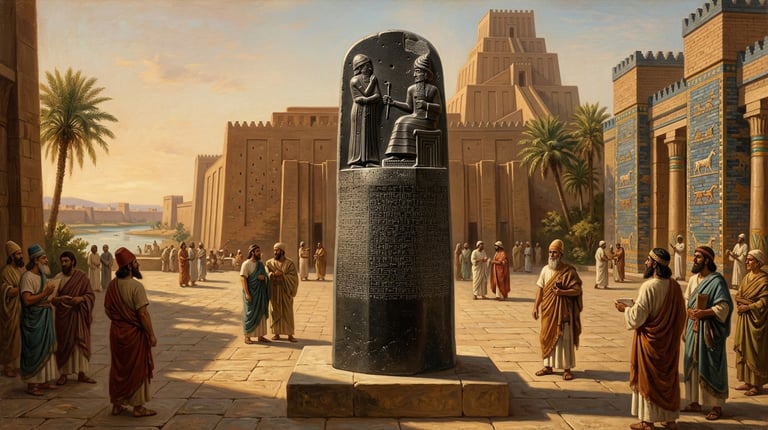
The Code of Hammurabi, one of the oldest known sets of laws, was created by Hammurabi, King of Babylon, around 1754 BC. Its historical importance is not limited solely to the substance of the laws but also extends to its unique structure. The code was carved onto stelae—large stone pillars—with the laws inscribed in a way that was easily legible for the citizens of the era. This choice of material and presentation was intended to ensure that the rules were accessible and visible to all.
The code contains a total of 282 specific laws, each dealing with different aspects of social, economic, and personal life in ancient Babylon. The laws range from property regulations, which outline how land and goods must be handled, to norms concerning labor rights, as well as legislation on family matters governing marriage, divorce, and inheritance. Furthermore, the Code stipulates severe punishments for various crimes, reflecting the Babylonian society's view of justice, where the concept of "an eye for an eye, a tooth for a tooth" was predominant.
Practical examples of this legislation include laws requiring financial compensation for damage caused to another's property and others ensuring rights for workers who suffered injuries while performing their duties. Provisions on family matters establish rights for women in divorce situations and regulations regarding child guardianship. Thus, the Code of Hammurabi was not just a compilation of legal mandates, but a direct reflection of the social norms of the era, which sought to balance collective justice and individual rights.
Fundamental Principles and Philosophy
The Code of Hammurabi does not merely lay down judicial statutes; it encapsulates the foundational ethical and philosophical principles of Babylonian society. Among its central concepts is the lex talionis (law of retaliation), or the idea that punishment must match the crime committed. This premise reflects a pursuit of retributive justice, where every offense yields a proportional response, as evidenced by the famous maxim "an eye for an eye, a tooth for a tooth."
This concept of proportionality is not merely a rule for retaliation; it expresses a social norm intended to maintain order within the community. By basing itself on equity as a principle, the code sought to guarantee that punishments were fair and to prevent disproportionate reprisals that could trigger endless cycles of vengeance.
In addition to the lex talionis, the Code of Hammurabi reflects moral values deeply rooted in ancient Babylon, such as the mandate to protect the vulnerable. In many instances, the established laws seek to secure fundamental rights and duties essential for harmonious coexistence, including property rights and safeguards against injustice and oppression.
These ethical principles did not only inform legal practices; they actively shaped the social perception of what constituted justice and morality. The codification of the laws allowed citizens to understand their obligations and rights clearly, contributing to a collective commitment to social order and stability. Thus, the principles underpinning the Code of Hammurabi did not just mold Babylonian jurisprudence; they became a milestone in the evolution of subsequent legal civilizations.
The Code's Impact on Babylonian Society
Compiled in the 18th century BC, the Code of Hammurabi represents a foundational milestone in the history of civilizations, particularly within Babylonian society. The laws contained in this code did not merely outline a rigid set of rules; they actively shaped the daily lives of Babylon's inhabitants, establishing a baseline for social justice. By introducing principles such as accountability and fairness, the Code directly affected social and economic interactions among Babylonians, fostering a sense of order and predictability.
One of the most notable applications of the Code was its ability to regulate relationships across different social classes. The laws were designed to apply different treatments based on an individual's social standing, reflecting the existing hierarchical structure. At the same time, however, the Code sought to guarantee that even the less privileged possessed some level of protection and redress in legal disputes. This emphasized a principle of justice where the boundaries of tolerance and acceptable behavior were clearly defined, allowing justice to manifest across various spheres of life.
The role of the government in enforcing the law was equally crucial. The Code did not only assign responsibilities to judges and rulers; it emphasized the paramount importance of their impartiality and integrity when executing justice. Rulers were expected to ensure that laws were applied fairly, thereby creating a bond of trust between the population and their authorities. This interaction between government and citizens helped strengthen social cohesion within Babylon.
Beyond its influence on Babylonian society, the Code of Hammurabi had a lasting impact on other civilizations. The principles established by Hammurabi served as an inspiration for subsequent legal systems, echoing in the formation of laws in societies such as the Romans and contributing to the evolution of the concepts of justice and governance. Thus, the Code of Hammurabi did not just shape its own time and place; it laid the groundwork for the development of legal understanding in future civilizations.
Comparison with Other Ancient Legal Codes
Dating back approximately to 1754 BC, the Code of Hammurabi is one of the oldest and most influential sets of laws in human history. For a deeper understanding of its legal context, it is insightful to compare it with other ancient legal codes, such as the Code of Ur-Nammu and the Mosaic Law.
The Code of Ur-Nammu, which appeared roughly 200 years before the Code of Hammurabi, is remarkable for its attempt to provide fairer and less severe punishments. While the Code of Hammurabi is known for its rigid penalties that frequently include physical retaliation, the Code of Ur-Nammu proposed monetary fines as a primary form of penalty, reflecting a more restorative approach to justice. For example, injuring a person's limb could result in financial compensation rather than "an eye for an eye." This distinction highlights an evolution in legal thinking where emphasis was placed on reparation rather than direct punishment.
The Mosaic Law, which developed later, presents notable similarities and differences when compared to the Code of Hammurabi. Both collections of laws incorporate precepts regarding morality and justice, alongside regulating the daily life of society. However, the Mosaic Law introduces elements of mercy, emphasizing the importance of repentance and redemption. While penalties under Mosaic law frequently included capital punishment, they also established a connection between divine justice and the application of law. This distinguishes it from the Code of Hammurabi, which leaned more on a secular and often harsh approach.
In summary, by comparing these ancient legal codes, we can observe not only how early societies interpreted justice but also how approaches toward penalties and morality evolved across generations. This analysis offers valuable insights into the development of law and justice throughout history.
The Legacy of the Code of Hammurabi in History
Considered one of the first and most significant sets of written laws in history, the Code of Hammurabi had a profound and lasting impact on the judicial systems that followed. Drafted in the 18th century BC in ancient Babylon, this code did not only establish civil and penal norms; it introduced the concept of retributive justice, dictates that punishment must be proportional to the crime committed. This concept significantly influenced how societies understood and implemented law over the centuries.
Throughout the eras, the Code of Hammurabi served as a reference point for subsequent lawmakers and societies. Civilizations such as the Romans and the Greeks were influenced by its clauses that emphasized respect for property and human dignity. The critical codification of laws and the idea that everyone should be treated in a fair and equitable manner were fundamental concepts that emerged from this historic document. The principle that laws must be written down and widely publicized, as championed by Hammurabi, also became an essential characteristic of modern legal systems.
In contemporary times, the principles found in the Code of Hammurabi resonate in discussions regarding human rights and social justice. Its legacy continues to be evoked as a paradigm for creating judicial structures that recognize the dignity and rights of individuals. Today, scholars and jurists frequently cite the Code of Hammurabi when addressing legal themes, demonstrating how, even thousands of years after its creation, its ideas continue to provide a foundation for understanding the evolution of law and justice.
Current Relevance of the Code of Hammurabi
The Code of Hammurabi is not merely a relic of the past; it continues to hold relevance in contemporary discussions on justice, ethics, and legislation. This ancient Mesopotamian set of laws introduced fundamental concepts that still echo in modern legal practices. The principle of retributive justice, which dictates that penalties must be proportional to the offense committed, remains an ideal mirrored in current legal frameworks.
In the present day, issues of civil rights, social justice, and judicial systems are frequently debated, and the Code of Hammurabi serves as a historical baseline for these discussions. For instance, the idea that law must be clear and accessible to all citizens can be seen in the way modern constitutions are drafted, aiming to promote transparency and equity. This ideal is critical in a world where many still struggle against vaguely defined laws that can be interpreted in ways that favor specific groups.
Furthermore, the challenges faced by modern societies—such as inequality, discrimination, and the pursuit of an impartial judicial system—reflect dilemmas that existed even during the era of the Code of Hammurabi. The debate over the scope of legal rights and how to apply them fairly continues to reverberate, showing that while the context and circumstances have changed, the fundamental principles of justice remain deeply relevant.
Ultimately, looking back at the Code of Hammurabi reminds us that there are lessons to be learned about the nature of law and society. Ancient legislation offers not only a historical perspective but also a framework for confronting contemporary legal issues, reaffirming the importance of fair and equitable rules to guide human behavior through to the present day.
📚 Continue Exploring Key Points in History:
Sparta or Athens?
The Maya Civilization
The Pax Romana
Curiosities About the Kingdom of Kush



contato@pontoschavedahistoria.com.br
© 2026. All rights reserved.