

The Wars of Scottish Independence
The Legacy of William Wallace and Robert the Bruce
Medieval Scotland
Medieval Scotland, especially during the 12th and 13th centuries, was a period of immense political and social complexity that ultimately culminated in the Wars of Independence. Within this context, the relationship with England was defined by frequent tensions, as the English crown continuously attempted to assert dominance over Scotland, while the Scots fought to preserve their autonomy and cultural traditions.
At the beginning of the 13th century, Scotland was a nation striving for political stability. The kingdom was ruled by the Canmore dynasty, but recurring succession crises and internal disputes frequently undermined national unity. The death of Alexander III in 1286, without a clear successor, exacerbated these problems and allowed King Edward I of England to intervene directly in Scottish politics. Asserting that he held feudal rights over the Scottish crown, Edward I initiated a chain of events that led to the invasion and subjugation of the kingdom.
Social tensions were equally severe. The Scottish people often found themselves divided between loyalties to local nobles and the English crown, reflecting deep conflicts of interest that bred widespread distrust and division. Consequently, aspirations for liberty and a distinct national identity began to be forged by local leaders who rose up against oppression, gathering growing popular support for the independence struggle.
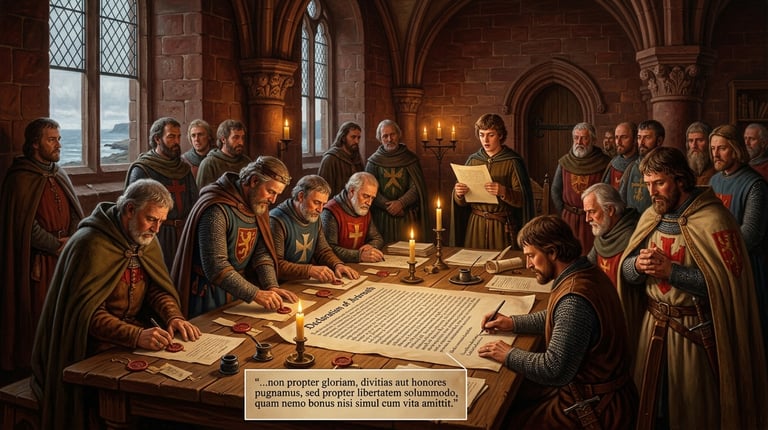
The Wars of Scottish Independence were, therefore, a direct response to decades of political and social friction. Deep-seated dissatisfaction with English rule, combined with a profound yearning for freedom, served as the backdrop that prepared the ground for figures like William Wallace and Robert the Bruce. These leaders emerged as symbols of resistance, galvanizing the fight for autonomy and Scottish sovereignty—elements that would prove fundamental to the formation of the Scottish national identity we recognize today.
The Figure of William Wallace
William Wallace, one of the most iconic personalities in Scottish history, was born around 1270 in Elderslie, Renfrewshire. From his youth, Scotland was already experiencing highly impactful political tensions, particularly regarding English dominance. Growing up in a climate of conflict heavily influenced his determination to fight for Scotland's independence.
Wallace emerged as a prominent figure in the Scottish resistance following the death of King Alexander III in 1286, which had left Scotland without a strong leader and exposed to English invasion. Starting in 1297, he led a series of memorable battles, the most notable being his triumph at the Battle of Stirling Bridge. In this clash, Wallace utilized brilliant guerrilla tactics to decisively defeat a numerically superior English army. This victory not only consolidated his status as a national hero but also inspired countless Scots to rally to the cause of independence.
Beyond his military victories, William Wallace is defined by his enduring role as a symbol of resistance and freedom. His struggle was not driven by personal gain, but by a deep desire to liberate his homeland from the yoke imposed by the English. He was appointed Guardian of Scotland and laid the groundwork for the independence movement, fostering a powerful sense of unity among the different Scottish clans. Wallace became a charismatic and strategic leader whose ideals of independence and valor resonated profoundly with the common people.
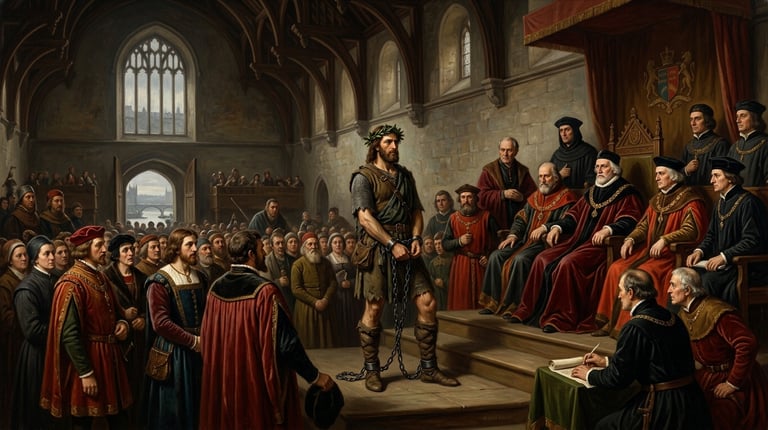
Tragically, Wallace's journey came to a brutal end in 1305, when he was captured, betrayed, and executed by the English crown. However, his legacy endures, having influenced future generations and becoming one of the foundational pillars of Scotland's fight for liberty. The life of William Wallace is not merely a historical narrative of courage and resistance, but a lasting testament to the eternal human desire for freedom and self-determination.
The Battle of Stirling Bridge
The Battle of Stirling Bridge, fought on September 11, 1297, is a monumental milestone in the Wars of Scottish Independence. This confrontation, led prominently by William Wallace and his ally Andrew Murray, not only altered the course of the war but also became a timeless symbol of the Scottish fight for freedom. The battle was strategically won through location; the Scottish forces brilliantly exploited the geography of the terrain and the narrow structure of the bridge to confront and overcome a numerically superior English army.
One of the most remarkable aspects of the battle was Wallace's deployment of intelligent tactics. He recognized that Stirling Bridge was a critical choke point where a small number of Scottish soldiers could hold off a massive English contingent. As the English vanguard crossed the bridge, the Scottish army launched a decisive and sudden downhill attack, cutting off the enemy's retreat and utilizing their intimate knowledge of the muddy terrain to inflict devastating casualties. This act of bravery not only secured victory but also electrified the morale of the Scottish troops, revitalizing a cause that had been at a critical crossroads.
Beyond the immediate impact of the victory, the Battle of Stirling Bridge had long-term consequences for Scotland's independence. The figure of William Wallace emerged as a national icon, symbolizing Scottish resilience and an unyielding determination to achieve freedom. The victory helped solidify widespread popular support around the independence movement, transforming Wallace from a regional guerrilla leader into a national symbol of the struggle against English oppression. The legacy of this battle endures to this day in the collective memory of Scotland, reaffirming the vital importance of its central figures in national history.
Robert the Bruce and His Rise to Power
Robert the Bruce, a towering figure in the struggle for Scottish independence, was born in 1274 into a prominent aristocratic family with deep Scottish roots. His upbringing was marked by a strong sense of national identity, which would lead him to play a vital role in the Wars of Scottish Independence. Throughout his youth, Bruce navigated the complex political intrigues of his era, striving for a prominent position among the Scottish leadership.
In 1296, following the English invasion and subjugation of Scotland, the political situation deteriorated rapidly. Bruce initially allied himself with the English King, Edward I, out of political necessity. However, his long-term ambitions eventually led him to switch sides, fully backing the fight for independence. In 1306, following a violent confrontation with rivals who questioned his claim to the Scottish throne, Bruce made the decisive choice to seize the crown. His coronation at Scone was a powerful symbolic act that solidified his position as the true leader of the Scottish resistance.
Bruce faced the monumental task of uniting the Scottish clans, who were frequently fractured by competing loyalties to different nobles. His victory at Bannockburn in 1314 was a crucial turning point, firmly establishing Bruce's status as both king and military commander. His bold battlefield strategies, combined with a sharp skill for forging political alliances, were vital in securing successes against the English, who were determined to maintain their grip on Scotland. Bruce established himself not just as a great commander, but as an enduring symbol of national resilience.
Throughout his life, Robert the Bruce's rise to power and his unwavering determination to secure Scottish freedom significantly shaped the course of the Wars of Scottish Independence. His legacy remains a testament to the fight for sovereignty and national identity, continuing to inspire future generations in their pursuit of liberty and justice.
The Battle of Bannockburn
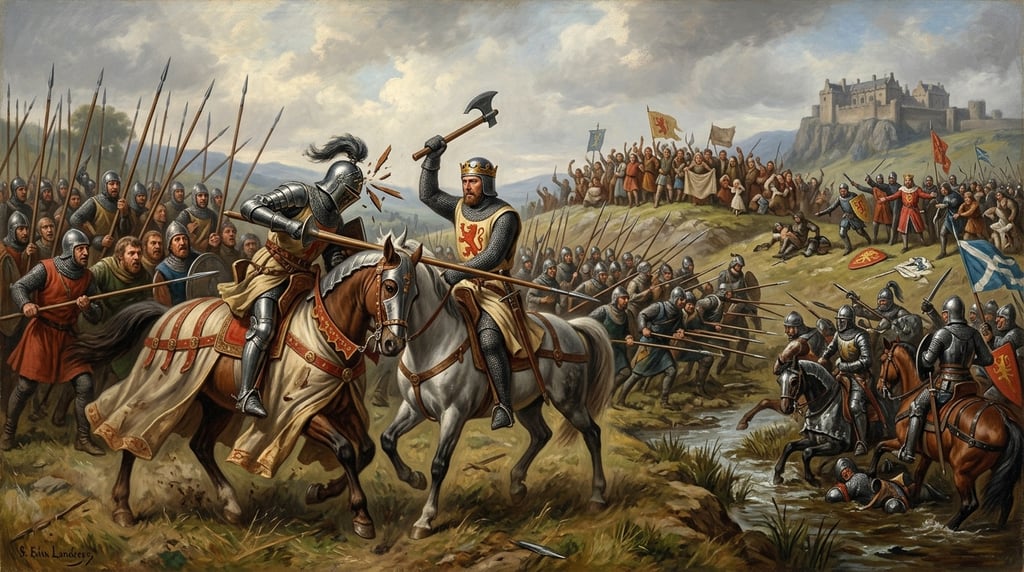
The Battle of Bannockburn, fought between June 23 and 24, 1314, is widely considered the ultimate turning point in the Wars of Scottish Independence. Under the brilliant leadership of Robert the Bruce, the Scottish army faced the significantly larger and heavily armed forces of King Edward II of England, demonstrating that determination and superior strategy could overcome an immense numerical disadvantage. This clash not only consolidated Robert the Bruce’s position as the rightful leader of the independence movement, but also reinforced the legendary resilience of the Scottish people.
The tactics employed by Bruce were absolutely crucial to the victory. By positioning his troops on ground that was highly unfavorable for the heavy English cavalry, Bruce masterfully exploited the marshy areas surrounding his camp, forcing the enemy into congested and treacherous conditions. Furthermore, the utilization of formidable schiltrons (tightly packed defensive formations of pikes) coupled with his strategic exploitation of the terrain allowed the Scots to maximize their combat effectiveness despite being heavily outnumbered.
The results of the Battle of Bannockburn were profound. The Scottish victory provided an immense moral boost to the nation and established a clear path toward self-sufficiency. The triumph at Bannockburn reasserted Robert the Bruce's claim to the Scottish throne and forced the eventual international recognition of Scotland as a fully independent nation. Therefore, Bannockburn is frequently celebrated not just as a military masterpiece, but as a cultural icon that permanently molded Scottish identity, perpetuating the legacy of Robert the Bruce and his vital role in the history of Scotland.
The Legacy of Wallace and Bruce
The legacy of William Wallace and Robert the Bruce is of paramount importance to the history of Scotland, not only for their military conquests but for the profound way they shaped the Scottish national identity. Wallace, a charismatic and fearless leader, and Bruce, an astute and determined strategist, inspired generations with their fights for freedom. Their achievements during the Wars of Scottish Independence symbolize the resistance and determination of the Scottish people when facing systemic oppression.
Through his leadership at the Battle of Stirling Bridge in 1297, Wallace became an undying icon of the Scottish crusade for liberty. His bravery and ultimate sacrifice served as a rallying cry for all Scots, uniting them around a single, shared goal: total independence. The narrative of his actions was famously brought to life in the epic film Braveheart, which, despite taking dramatic liberties, captured the raw essence of his struggle and caused it to resonate deeply within contemporary popular culture.
On the other hand, Robert the Bruce consolidated Wallace’s legacy by becoming the King of Scotland and commanding the decisive victory at Bannockburn in 1314. This victory did not just guarantee Scottish control over their own lands; it solidified his position as an eternal symbol of defiance. Bruce is remembered for his highly innovative military tactics, which frequently inspire strategic warfare studies to this day. The nationwide celebration of his achievements, marked by statues and monuments across the country, reflects how deeply Scotland reveres its heroes.
The influence of Wallace and Bruce endures vividly in modern culture. William Wallace Day and various commemorative events in honor of Robert the Bruce demonstrate how their legacies remain an active source of inspiration. The fight for Scottish identity that they championed remains incredibly strong, reinforcing the values of freedom and autonomy—core characteristics that define Scottish culture to this day.
The Cultural Influence of the Wars of Independence
The Wars of Scottish Independence, dominated by the remarkable figures of William Wallace and Robert the Bruce, left a profound and permanent impact on Scottish culture and its expression throughout the Western world. These leaders' fight against English oppression became a global symbol of resistance and unity, reverberating not only through history books but also through the arts, literature, and cinema. The epic narrative of freedom and the pursuit of self-determination has been thoroughly explored in countless works, permanently reinforcing the archetype of Scottish heroism.
In literature, the Wars of Independence inspired a massive body of work spanning from romantic poems to rigorous historical accounts. Poets like Robert Burns, writing in the 18th century, masterfully captured the nationalist spirit and raw bravery of Scottish warriors in classic works. Historical fiction also flourished, utilizing the figures of Wallace and Bruce as archetypes of charismatic leaders standing tall against tyranny. These literary contributions were instrumental in building a stronger Scottish national identity, fostering a deep collective awareness of Scotland's history.
In cinema, the most famous representation of these historical figures is found in the 1995 film Braveheart, which dramatized the life and battles of Wallace. This cinematic masterpiece not only popularized the history among the general global public but also ignited a massive, renewed interest in Scottish heritage, tourism, and culture. Through its heroic and emotional storytelling, the film helped shape public perceptions of Scotland worldwide, shining a bright spotlight on its historical resilience and ancient fight for liberty.
Furthermore, this cultural influence extends far beyond media and arts; it thoroughly permeates local festivals, Highland games, and historical re-enactments where history is actively kept alive and passed down through generations. The enduring image of Wallace, with his iconic sword and unyielding determination, continues to serve as a universal benchmark for the fight against injustice—a definitive cornerstone of Scottish consciousness and a legacy that will endure through the centuries.
📚 Continue Exploring Key Points in History:
The Hundred Years' War
The Islamic Expansion
The Viking Invasions
contato@pontoschavedahistoria.com.br
© 2026. All rights reserved.